

Energy bill audit
An energy bill audit for companies with many locations. We read the invoices, break down the tariff, contracted capacity and additional charges, then hand over an action list ranked by value. A fixed fee per site.
Start with the invoices, not with the equipment
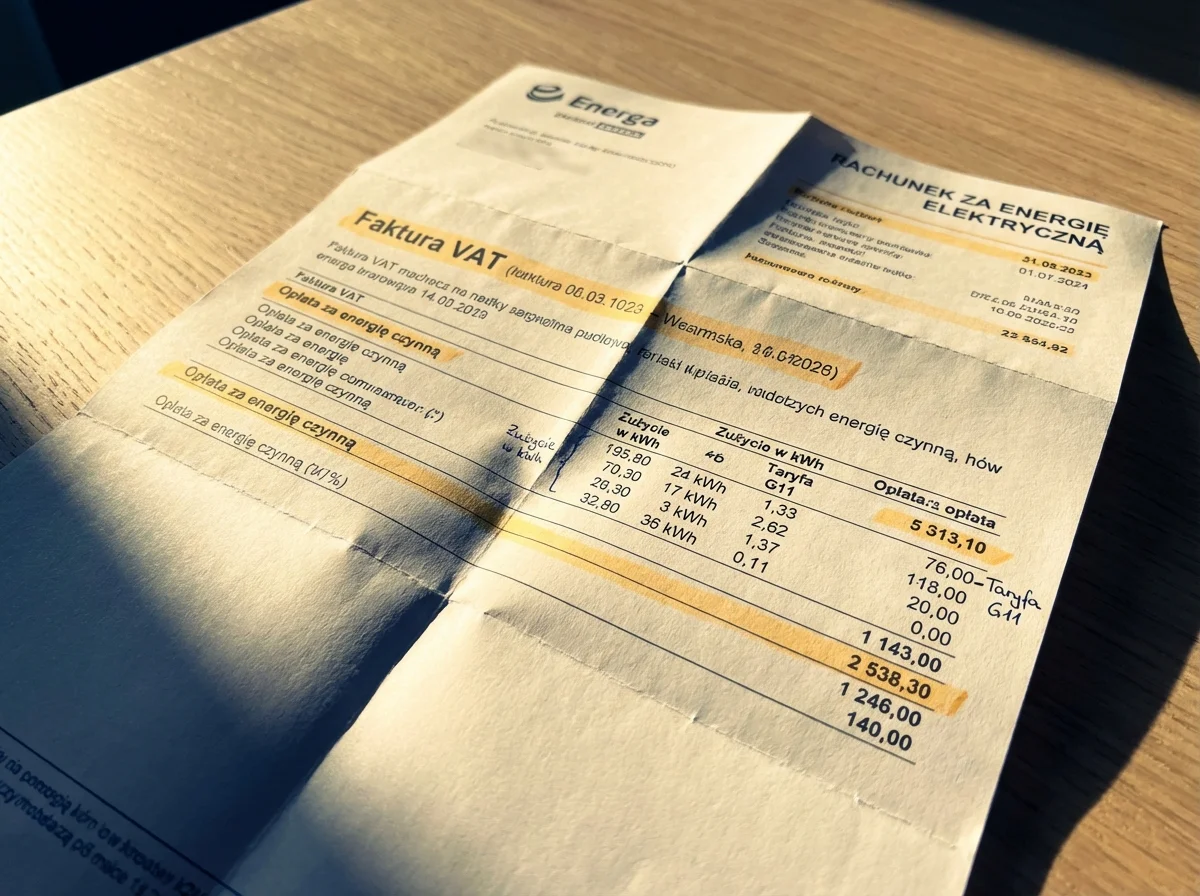
An energy bill audit (SVE Screen) is a review of invoices across an agreed group of sites, ending in an action list ranked by value. We break the invoice into its parts: tariff group, contracted capacity, distribution charges, reactive power and the terms on which energy is bought. We then show which items can be improved with a document or an application to the operator, and which require work in the installation. In multi-site companies a large share of the saving sits in the settlement itself rather than in new equipment, which is why we start from data you already hold. The service is separate from any installation: you pay a fixed fee per site, and we hand over the result even when the conclusion is "buy nothing".
Why it is worth it
The whole invoice broken into parts
Tariff group, contracted capacity, distribution charges, reactive power and the energy price. Each item separately, with an annual amount stated.
An action list ranked by value
Actions run from the cheapest, achievable with a document, to those requiring investment. Each carries the amount and the condition that has to hold.
Sites compared against each other
The same profile settled differently at two locations is the most common signal. The comparison shows where terms depart from the rest of the portfolio.
Contracted capacity checked against data
We set ordered capacity against real hourly demand. We name the oversized sites, and those where a correction risks an excess charge.
Reactive power and additional charges
We examine items that appear on the invoice without any change in consumption. We say plainly what follows from the installation and what follows from the settlement.
A result you can verify
Every recommendation is tied to an invoice line and a settlement period. You verify the effect on later invoices, not on a declaration.
A fixed fee per site, delivered as an action list with calculated value
A bill audit or a building energy audit?
| Criterion | Bill audit (SVE Screen) | Building energy audit |
|---|---|---|
| Subject of the study | Invoice, tariff, contracted capacity, charges | Insulation, heating, building performance |
| Data required | Invoices and contracts, remotely | Site visit and on-site measurement |
| Time to first result | Weeks | Months |
| Typical resulting actions | An application, an annex, a capacity correction | Thermal modernisation, heat source replacement |
| Scale | The whole portfolio at once | A single building |
Choose Bill audit (SVE Screen) if:
- You have a dozen or more supply points and different contracts
- You want to know the potential before deciding on investment
- You need ordered cost data behind a purchasing decision
Choose Building energy audit if:
- You are planning thermal modernisation of a specific building
- You are applying for a grant that requires an energy audit
- The problem is heat and building performance, not settlement
Advantages and limits
- A fast result on existing data
It requires no installation work, no downtime and no visit to every location. We work on invoices and contracts you already hold.
- Comparability across the portfolio
The same set of items for every site reveals departures that are invisible when reading a single invoice.
- A basis for an investment decision
Before you buy storage, PV or automation, you know how much comes from ordering the settlement alone and where equipment genuinely holds up.
- A service independent of any equipment purchase
You pay for the analysis, not for an introduction to an offer. We hand over the result even when we advise against investing.
- The report alone does not lower the bill
The saving appears after an application is filed, an annex signed or a change made in the installation. The report shows the route and the order.
- The result depends on complete data
Missing contracts or gaps in the invoices narrow the analysis. Hourly meter data noticeably raises the precision of the conclusions.
- Not every departure can be corrected
Some terms follow from the contract, the operator tariff or the nature of the site. We say plainly where there is no room to change.
- One site's result is not multiplied across the portfolio
Each location has its own tariff and profile. We state amounts per site, without extrapolating to the others.
The process
Scope and data access
We agree the list of sites, the decision-maker and how data will be provided. We need twelve months of invoices, the supply and distribution contracts and, where available, hourly meter data.
Extraction and ordering of invoices
Invoices pass through our data extraction and the reading is verified by hand. The result is one set of cost items across the whole portfolio, comparable site by site.
Analysis of items and profile
We break the cost into tariff, capacity, distribution, reactive power and energy purchase. We set that against the demand profile and identify items that depart from the rest of the portfolio.
Report and a conversation about decisions
We hand over the action list with amounts, conditions and sequence. We go through it with you and identify what can be done in-house and where a contractor is needed.
Verification of the effect (optional)
After implementation we check subsequent invoices and confirm whether the change actually entered the settlement. This is a separate continuing service, billed monthly.
What does an energy bill audit cost?
| Bill audit, first batch of sites fixed fee per site, typically 10 to 20 locations | individual quote |
| Further batches from the same portfolio lower rate per site where the data format repeats | individual quote |
| Verification of the effect on later invoices continuing service, billed monthly | individual quote |
| Single-site analysis (SVE Analyze) when you need the hourly profile and technical recommendations | individual quote |
We quote after reviewing sample invoices from two sites. The bill audit is a standalone service, not a condition of buying an installation. Scope and sequence are agreed with the person who can commit the first batch.
Related services
Complete energy solutions for your home and your business.
Energy consumption analysis
SVE Analyze: an invoice and load-profile audit with concrete recommendations
View
Energy management for business (EMS)
An energy management system and ESG reporting across many sites
View
Energy consumption monitoring
SVE Detect: generation and consumption under control 24/7
ViewWant to know more? Let's talk about your project
Book a free consultation. We will go through your needs and give you an initial quote.